Solve Circle Geometry Instantly
Geometry often presents challenges when calculating dimensions of round objects. You need accurate measurements for construction, design, or academic homework. This circle calculator provides immediate values for radius, diameter, area, and circumference. You input one known value. The tool computes all other metrics using constant mathematical pi.
How to Use the Circle Calculator
Follow these steps to find your dimensions:
- Select the unit of measurement for your input.
- Enter your known value into the corresponding field.
- Review the results for radius, diameter, circumference, and area.
- Copy the data for your project or assignment.
The tool uses standard geometric rules to ensure precision across all outputs.

Circle Formulas and Logic
Mathematics defines a circle as all points in a plane at a fixed distance from a center point. Understanding the relationships between these points requires specific formulas.
Radius and Diameter
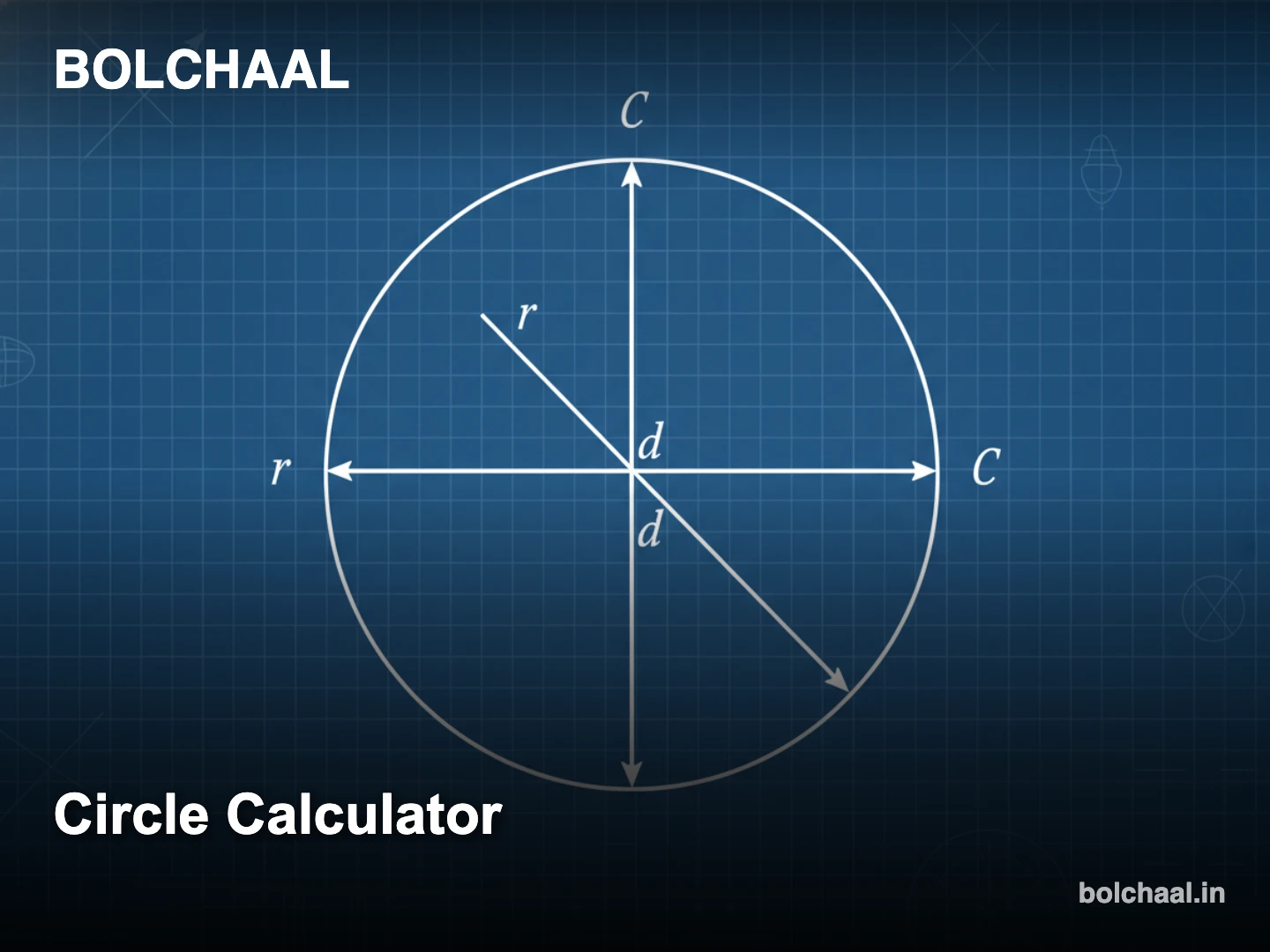
The radius represents the distance from the center to any edge. The diameter represents the total width through the center. Diameter equals two times the radius. Radius equals diameter divided by two.
Calculating Area
Area measures the space inside the circle boundary. The formula uses the square of the radius multiplied by pi. Area equals pi times radius squared. If you use diameter, the formula changes. Area equals pi times diameter squared divided by four.
Finding Circumference
Circumference measures the distance around the circle edge. It is the perimeter of the shape. Circumference equals two times pi times radius. You also calculate it by multiplying pi by the diameter.
Mathematical Constants
These calculations rely on Pi. Pi is an irrational number approximately equal to 3.14159. Modern calculators use higher precision versions of Pi for engineering tasks. High precision prevents rounding errors in large scale projects.
Practical Examples and Data
Consider a circular garden with a radius of 5 feet. The diameter spans 10 feet. The total walking distance around the edge is approximately 31.42 feet. The grass area covers 78.54 square feet.
Construction projects often require pipe measurements. A pipe with a 4 inch diameter has a 2 inch radius. Its cross sectional area is 12.57 square inches. These values help determine fluid flow rates in plumbing systems.

Benefits of Using This Tool
- Eliminate manual calculation errors.
- Save time on complex geometric problems.
- Verify homework answers for accuracy.
- Plan material purchases for circular DIY projects.
- Convert between radius and diameter instantly.
Applications in Professional Fields
Engineers use circle math to design gears and pulleys. Architects apply these formulas for arched windows and circular rooms. Machinists rely on diameter measurements to calibrate lathes. Graphic designers use these proportions to create balanced logos and icons. Every industry requiring spatial planning uses circle geometry.
You can find more advanced geometry concepts at Math is Fun or study circle properties through Wolfram MathWorld.
Frequently Asked Questions
What is the easiest way to find a circle’s area?
Measure the distance from the center to the edge to find the radius. Multiply this number by itself. Multiply the result by 3.14159 to find the area.
How does diameter relate to circumference?
The circumference is always pi times larger than the diameter. If you triple the diameter, the circumference also triples. This ratio remains constant regardless of the circle size.
Can I find the radius if I only have the area?
Divide the area by pi. Take the square root of that result. This calculation gives you the exact radius of the circle.
Why is Pi used in every circle formula?
Pi represents the constant ratio of a circle’s circumference to its diameter. This ratio exists in every perfect circle found in nature or mathematics.
What units should I use for circle calculations?
Use consistent units for all inputs. If you enter the radius in inches, the area will be in square inches. The circumference will be in linear inches.