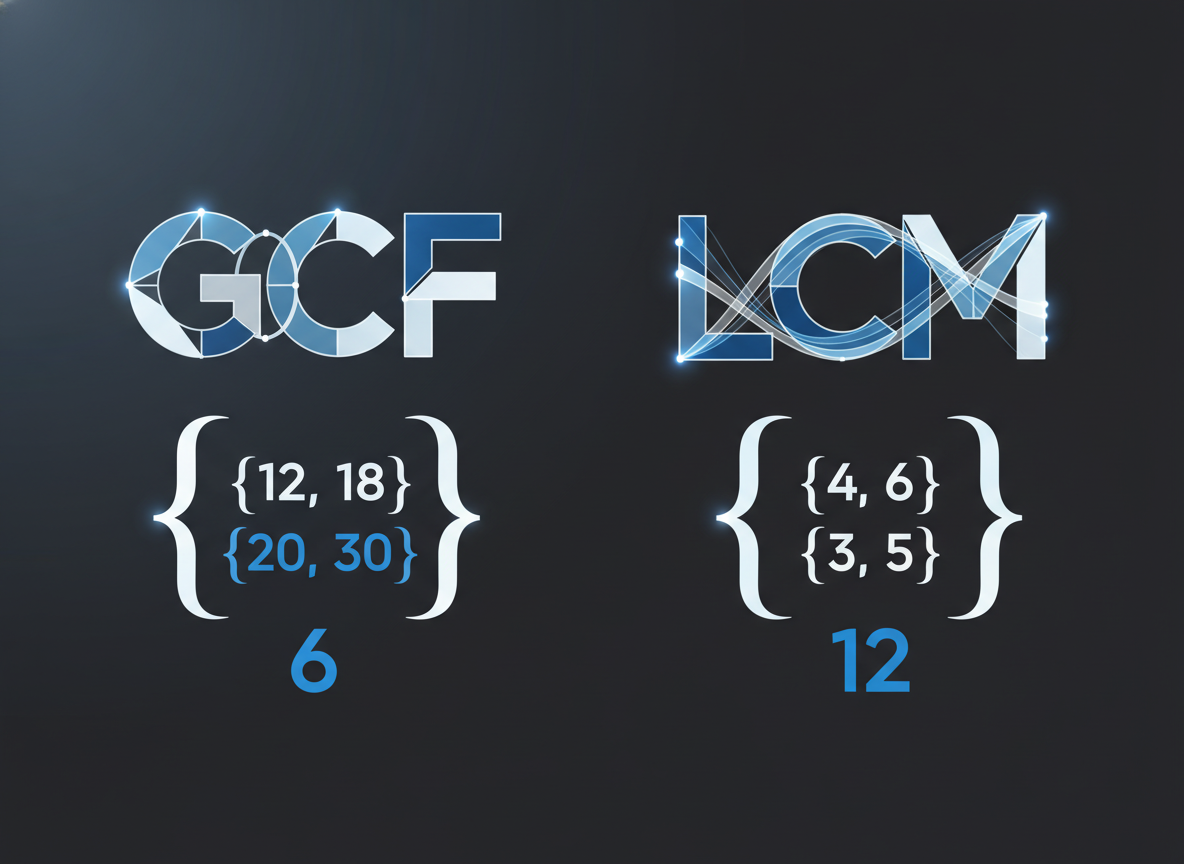
Solve Math Problems Instantly
Finding common factors and multiples manually takes time. Errors occur during long calculations. Our tool provides immediate results for any set of numbers. You simplify fractions, solve word problems, and manage algebraic expressions with precision.
How to Use the GCF and LCM Calculator
Follow these steps to get your results:
- Enter two or more positive integers into the input field.
- Separate each number with a comma.
- Click the calculate button.
- Review the GCF and LCM results displayed on your screen.

Understanding GCF and LCM
The Greatest Common Factor is the largest positive integer dividing each given number without a remainder. Educators often call this the Greatest Common Divisor. The Least Common Multiple is the smallest positive integer divisible by all numbers in your set.
The Formula for Two Numbers
A direct relationship exists between these two values. Use this formula for two numbers, a and b:
LCM(a, b) = (a * b) / GCF(a, b)
Methods of Calculation
Calculations rely on three primary methods. Prime factorization breaks numbers into their smallest building blocks. Listing factors works for small integers. The Euclidean Algorithm remains the most efficient choice for large numbers.
The Euclidean Algorithm Process
This method finds the GCF through repeated division. Follow these steps:
- Divide the larger number by the smaller number.
- Identify the remainder.
- Replace the larger number with the smaller number and the smaller number with the remainder.
- Repeat until the remainder becomes zero.
- The last non zero divisor is your GCF.
Prime Factorization Explained
To find the GCF using prime factors, identify the lowest power of every common prime factor. Multiply these values. To find the LCM, identify the highest power of every prime factor present in any of the numbers. Multiply those values together.

Practical Applications
Mathematical operations rely on these concepts daily. You use LCM to find common denominators when adding or subtracting fractions. GCF helps you simplify fractions to their lowest terms. Carpenters use GCF to cut materials into equal pieces without waste. Event planners use LCM to synchronize recurring schedules.
Example 1: Numbers 12 and 18
Factors of 12: 1, 2, 3, 4, 6, 12. Factors of 18: 1, 2, 3, 6, 9, 18. The common factors are 1, 2, 3, and 6. The GCF is 6. Multiples of 12: 12, 24, 36, 48. Multiples of 18: 18, 36, 54. The LCM is 36.
Example 2: Numbers 24 and 60
Prime factors of 24: 2^3 * 3. Prime factors of 60: 2^2 * 3 * 5. Common factors are 2^2 and 3. GCF is 12. Highest powers are 2^3, 3, and 5. LCM is 120.
Why Precision Matters
Inaccurate calculations lead to structural errors in engineering and financial discrepancies in accounting. Our calculator eliminates human error. It handles large datasets that are difficult to process mentally. You save time and ensure mathematical integrity in your work.
Academic Significance
Students master number theory by studying these relationships. Understanding factors builds a foundation for algebra and calculus. Reference resources like Wolfram MathWorld provide deeper technical insights into these operations. Use our tool to verify homework or prepare for exams.
Advanced Tips
- The GCF of two prime numbers is always 1.
- The LCM of two prime numbers is their product.
- If one number divides another, the smaller is the GCF and the larger is the LCM.